Deep Dive · Companies
The $1.8 Trillion Company Behind Claude
Anthropic just went public. We break down the IPO, the revenue, the losses, what each employee is “worth”, and what could go wrong from here.

ANT price by TradingView · Quotes may be delayed.
- IPO price per share
- $83
- Raised in the IPO
- $81.3B
- Fully diluted value at first close
- ~$1.76T
- Run-rate revenue, Oct 31
- ~$81B
- Net loss, first 9 months of 2026
- $104.0B
- Employees, Sep 30
- ~5,300
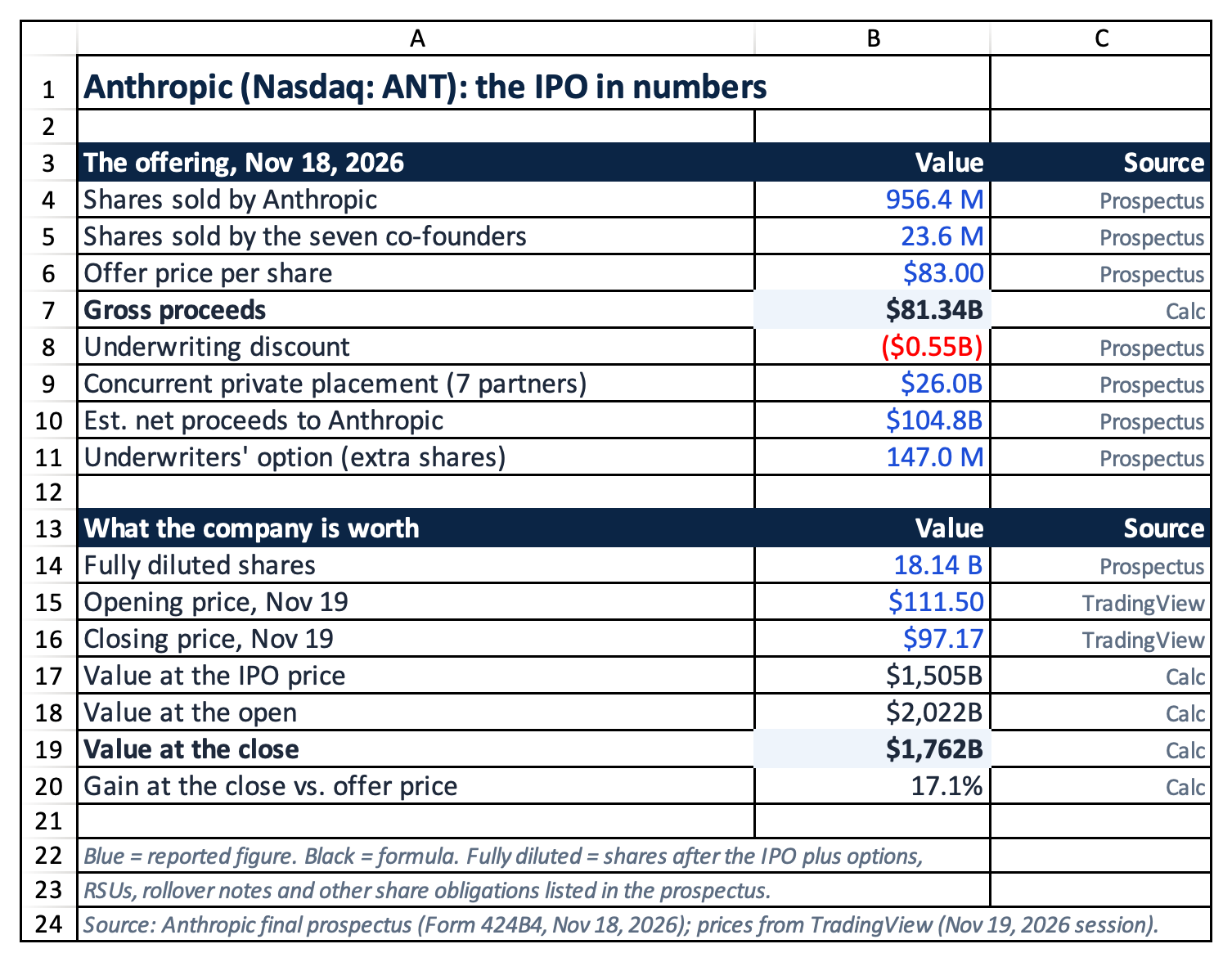
On November 19, 2026, Anthropic, the company behind the Claude AI assistant, started trading on the Nasdaq under the ticker ANT. By the closing bell it was worth about $1.76 trillion counting every share. Claude only went on sale in early 2023.
The IPO in numbers
It was one of the largest initial public offerings on record. Anthropic sold 956 million new shares at $83 each, and its seven co-founders sold 24 million of their own, for 980 million shares and $81.3 billion in total. After $550 million of underwriting fees, about $78.8 billion goes to Anthropic and $1.9 billion to the co-founders.
Right after the IPO, seven partners (Google, Nvidia, AMD, Broadcom, Micron, Microsoft and TSMC) are buying another $26 billion of non-voting shares at the same $83 price in a private placement. Anthropic expects about $104.8 billion in net proceeds from both, or about $117 billion if the banks use their option to buy 147 million extra shares.
The stock opened at $111.50, 34% above the offer price, and closed the day at $97.17, up 17%. The prospectus counts about 18.1 billion shares once options, stock awards and convertible notes are included, a fully diluted count. At the closing price, that values the company at about $1.76 trillion, or $1.8 trillion rounded. Counting only the roughly 13.2 billion shares already outstanding, the market cap TradingView shows, it is about $1.28 trillion.
From $25.91 to $97.17 a share in nine months
Anthropic’s last two private funding rounds show how fast its valuation climbed. Investors paid about $25.91 a share in February 2026 and $58.90 in May, more than doubling the price in three months. IPO buyers paid $83, about 41% more than May’s investors, and the stock finished its first day at $97.17, nearly 3.8 times the February price.
Why would anyone pay that much? The answer starts with what Anthropic sells, and how fast those sales are growing.
How Anthropic makes money
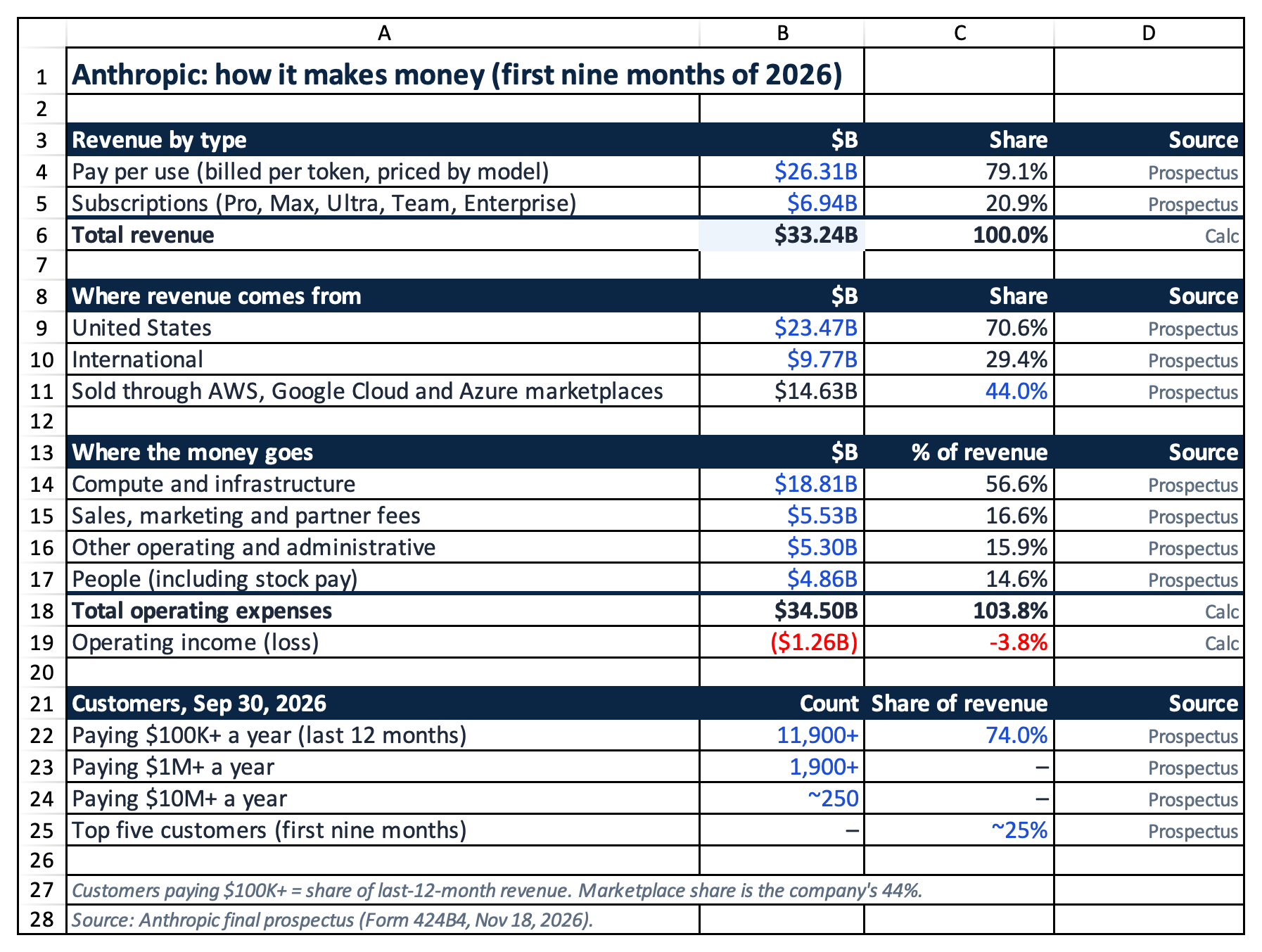
Anthropic sells access to its Claude AI models. Most of the money comes from usage: customers pay for every chunk of text the model reads and writes, measured in tokens, at a price set by the model they choose. That pay-per-use business brought in $26.3 billion, or 79% of revenue, in the first nine months of 2026. The other 21%, $6.9 billion, came from subscriptions such as the Pro, Max and Ultra plans and seats for teams and whole companies.
It sells at three levels. There are the models themselves: from most to least powerful, Mythos and Fable, Opus, Sonnet and Haiku. There is a platform developers use to build their own apps and AI agents. And there are its own apps, such as Claude Code for programmers and Cowork for office work. More than half of its biggest customers use both the platform and at least one of its apps.
Businesses are the core. About 11,900 customers spend $100,000 or more a year and bring in 74% of revenue, and roughly 40 million smaller customers make up the rest. About 44% of sales go through the cloud marketplaces of Amazon, Google and Microsoft. Anthropic keeps the customer contract but pays those clouds a fee, part of its $5.5 billion bill for sales, marketing and partnerships. About 29% of revenue comes from outside the US.
The biggest operating expense by far is computing power: $18.8 billion, or 57 cents of every revenue dollar. And Anthropic keeps cutting prices. Its newest Opus model does a typical task about 40% more cheaply than the last one, and price cuts lowered third-quarter revenue by about $600 million. The bet is on price elasticity: make intelligence cheaper and customers use far more of it.
Revenue: the reason for the price
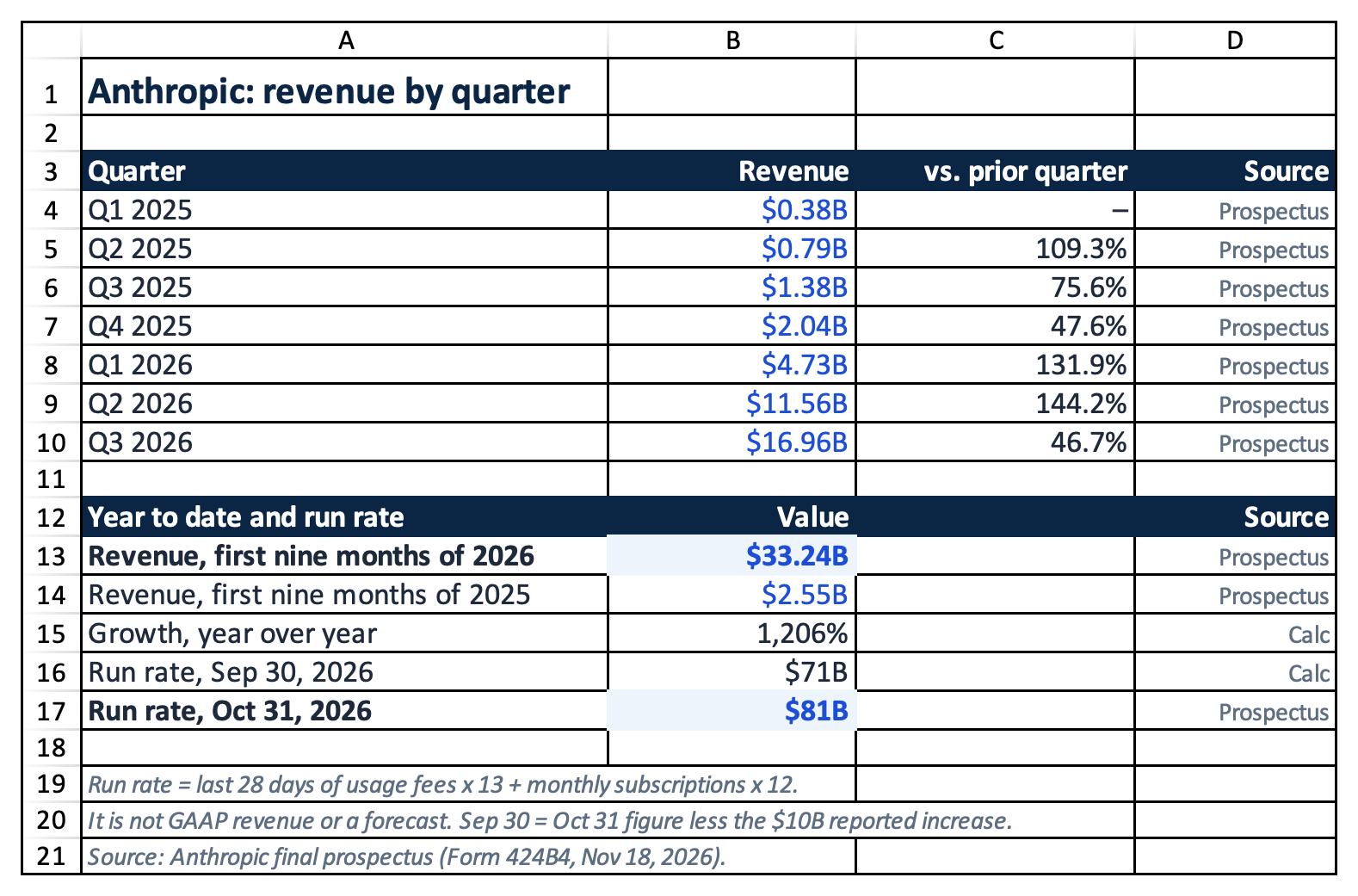
Anthropic’s revenue for the first nine months of 2026 was $33.2 billion, up 1,206% year over year. Quarterly revenue went from $376 million at the start of 2025 to almost $17 billion in the third quarter of 2026.
The company also reports a run rate: the last 28 days of usage fees times 13, plus a month of subscriptions times 12. It was about $81 billion at the end of October, up $10 billion in a single month. The prospectus stresses that this is not accounting revenue or a forecast. It also says 5% to 7% of revenue this year came from customers breaking its usage rules, a share it expects to shrink as enforcement tightens.
Is Anthropic profitable? There are three answers
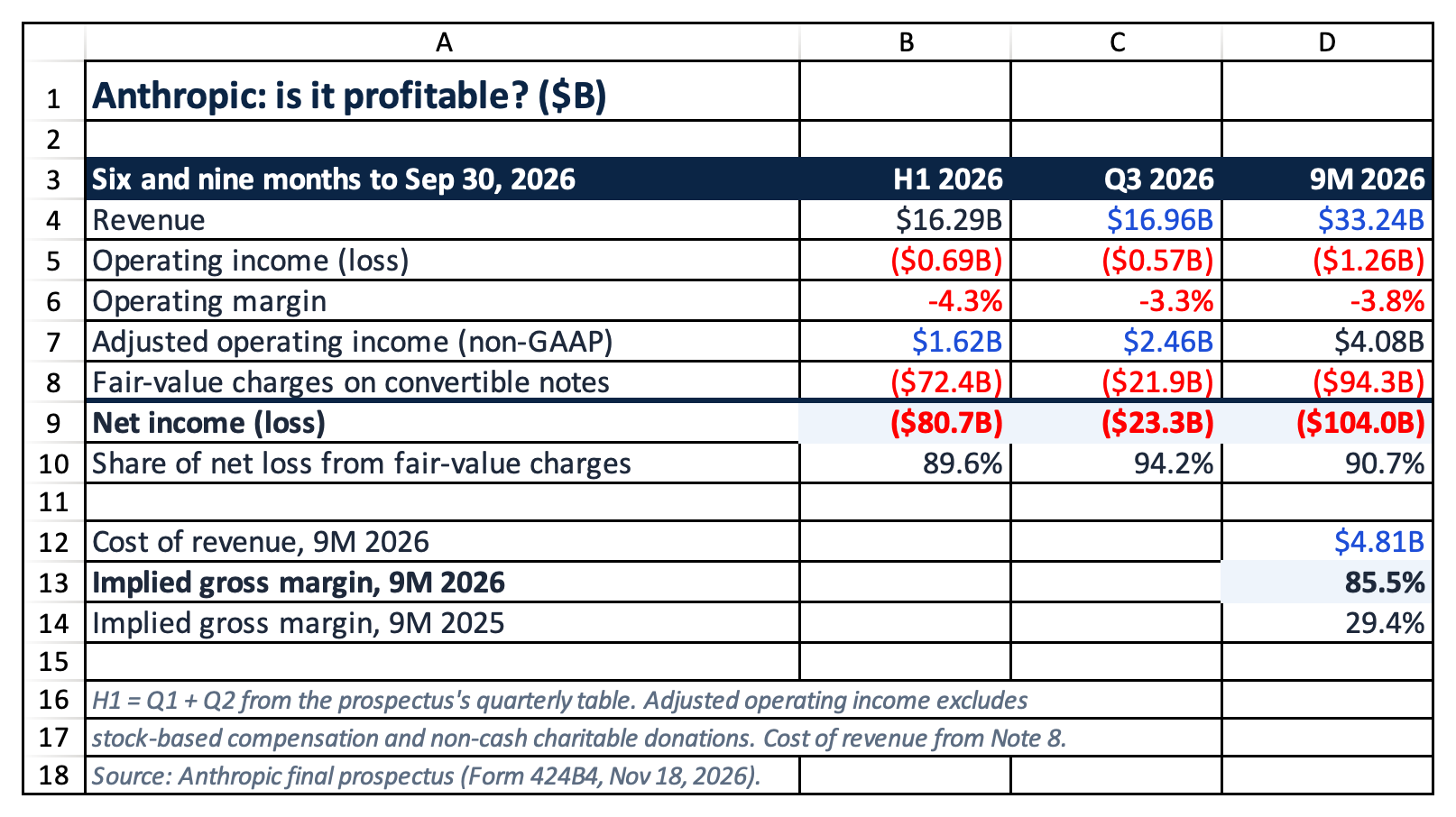
On paper: no, by a lot. Anthropic reported a net loss of $104.0 billion for the first nine months of 2026.
But most of that is accounting. $94.3 billion of the loss comes from re-measuring convertible notes and similar investor contracts at fair value. As Anthropic’s value soared, those contracts got more expensive on paper. Another $10.3 billion came from marking other financing contracts to market. None of it was cash.
The business itself is close to break-even. The operating loss was $1.3 billion, a margin of about −4%. Leave out stock-based pay and non-cash charitable donations and the company’s own adjusted figure is a $4.1 billion profit, a 12% margin. The second quarter was profitable, with $974 million of operating income, but the third quarter swung to a $567 million operating loss, mainly because of $5 billion of short-term computing power, which costs much more than its long-term contracts, and $2 billion of donation charges.
Margins have improved fast. Gross margin only counts the cost of serving customers. In the first nine months of 2026 that cost of revenue was $4.8 billion, almost all of it computing power that answers customer requests. The computing used to train and research new models is counted as research and development instead, which is why the gross margin is far higher than the 57 cents of computing per revenue dollar suggests. On that basis the gross margin was about 86%, up from about 29% a year earlier. The company warns its margins may shrink whenever large amounts of new computing power come online, because it pays for that capacity before the revenue arrives.
Cash in, cash out
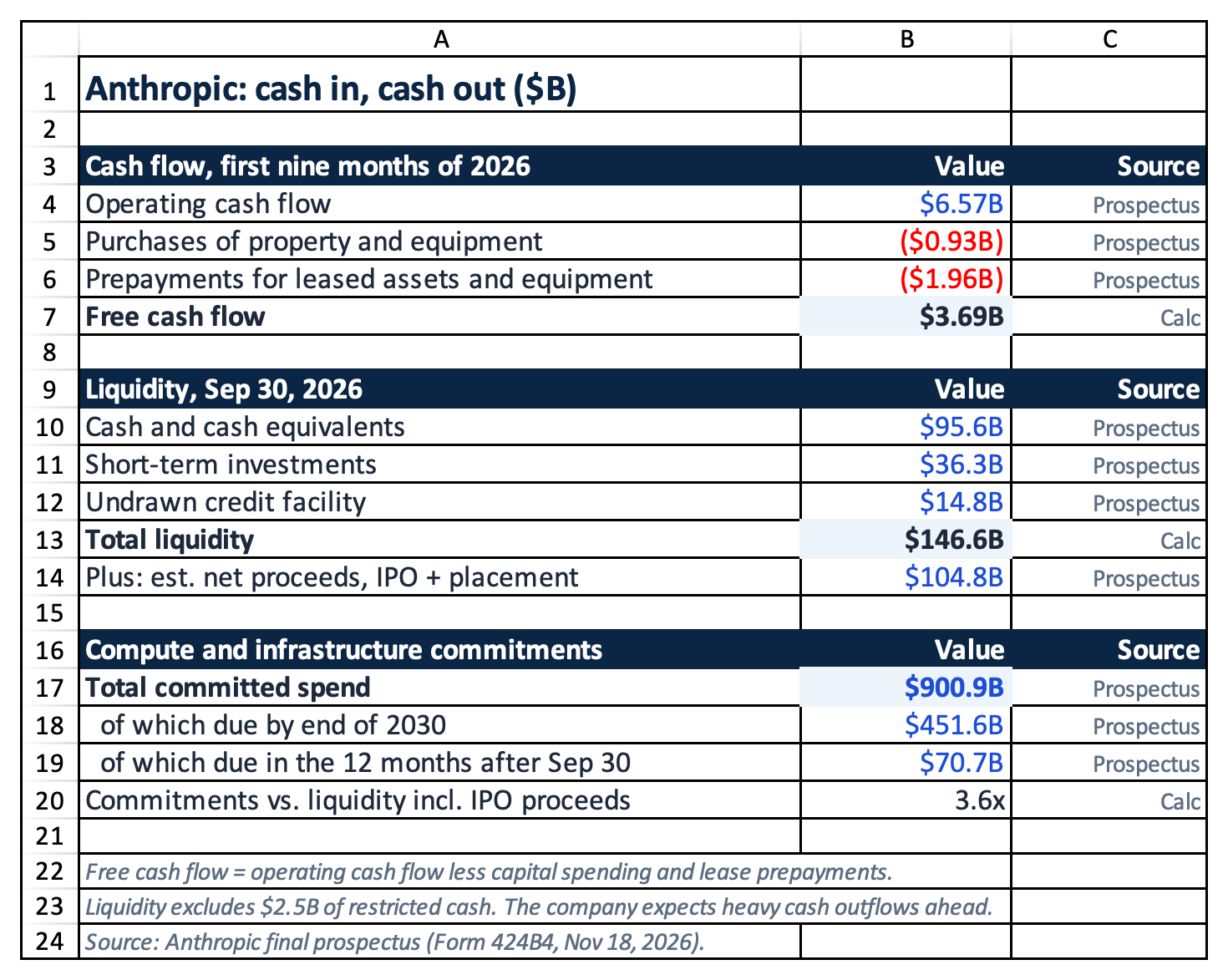
Day-to-day operations brought in $6.6 billion of operating cash flow in the first nine months of 2026. After $0.9 billion of capital spending and $2.0 billion of prepayments for leased equipment, about $3.7 billion was left over as free cash flow. So right now the company isn’t burning cash.
That is likely to change. Anthropic has signed about $900.9 billion of commitments, almost all of it for computing power and data centers. About $451.6 billion of that is due by the end of 2030, and $70.7 billion within the 12 months after September. The company expects building its own data centers to use a lot of cash for the foreseeable future. Against that, it had $146.6 billion of liquidity at the end of September, before the roughly $105 billion the IPO and private placement bring in.
Who runs Anthropic

Dario Amodei, formerly vice president of research at OpenAI, co-founded Anthropic in 2021 with his sister Daniela Amodei, now its president and board chair, and five other researchers who had worked at OpenAI.
Going public didn’t hand control to new shareholders. Anthropic is a public benefit corporation. A single share held by a “Founder LLC” owned by the seven co-founders carries 50.1% of all voting rights, an unusual form of dual-class shares. A separate Long-Term Benefit Trust elects a majority of the board. The prospectus says plainly that, under this corporate governance setup, ordinary shareholders generally won’t be able to change the outcome of a vote.
The biggest outside owners are Amazon, with 14.6% of the company, and Google, with 13.4%. Both are also major suppliers of Anthropic’s computing power, and Google is putting in another $10 billion through the private placement.
What is each employee “worth”?
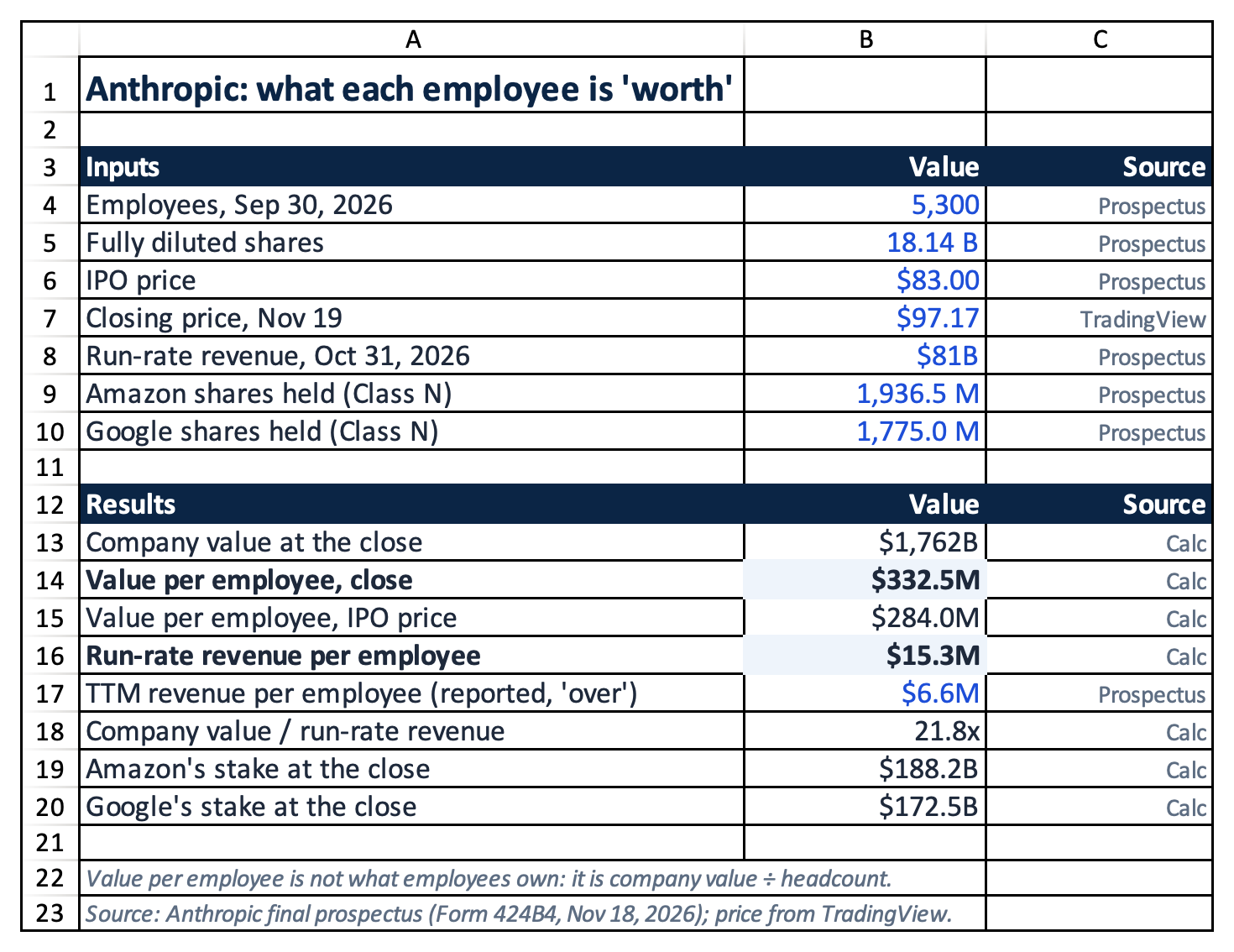
Anthropic had about 5,300 employees at the end of September, up from about 940 at the end of 2024. Divide the $1.76 trillion fully diluted market value at the first close by that and you get about $330 million of company value per employee. At the $83 IPO price, it’s about $284 million.
That isn’t what employees own. It shows how much value investors put on a small team. The revenue version is just as striking: Anthropic reports over $6.6 million of revenue per employee over the past 12 months, and the $81 billion run rate works out to about $15 million each. Each co-founder sold 3.38 million shares in the IPO, about $280 million apiece at $83, and each has pledged to give 80% of their Anthropic stock to charity.
Is $1.76 trillion justified?
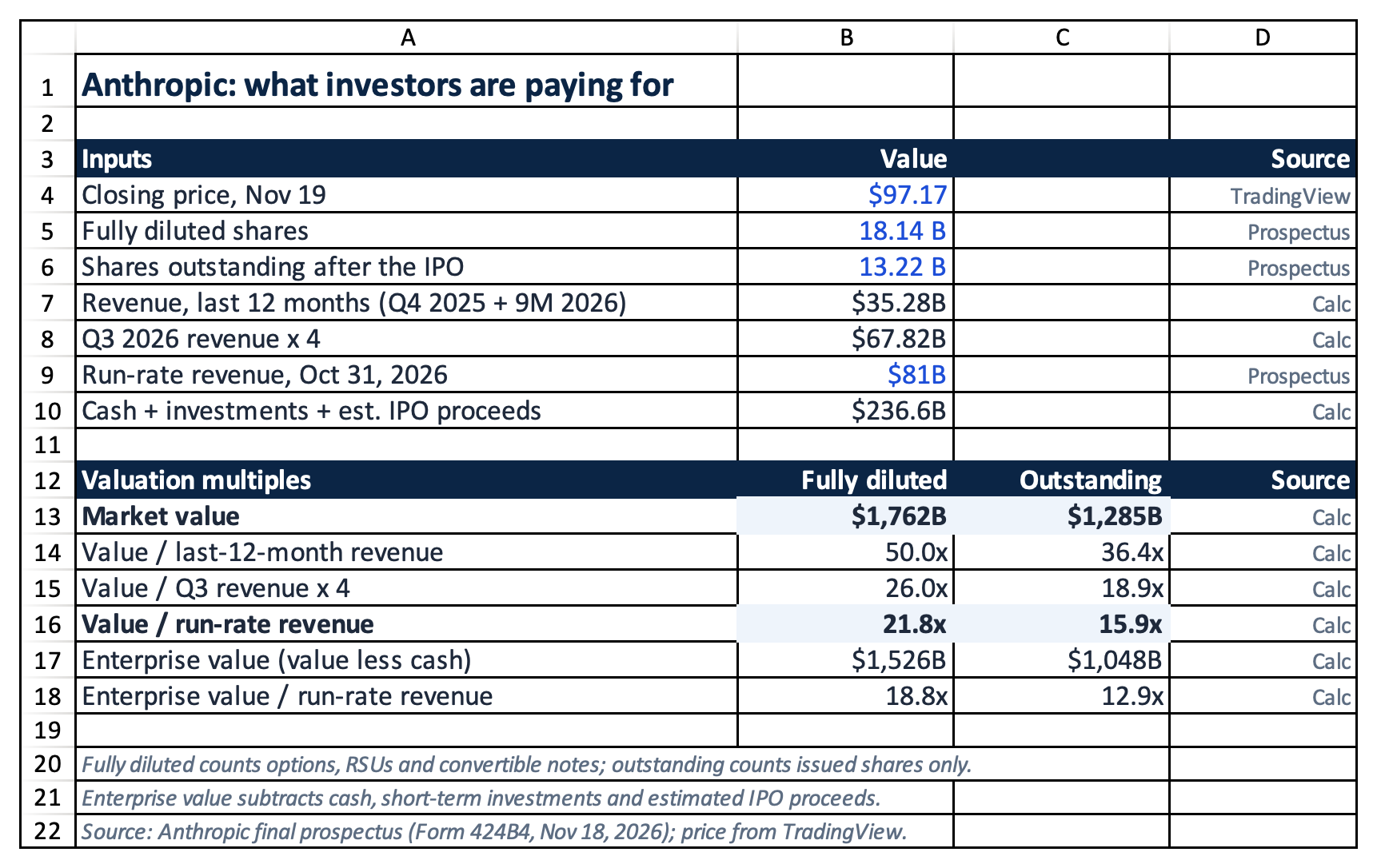
The simplest yardstick is the price-to-sales ratio: what investors pay for each dollar of yearly revenue. At the first close, Anthropic was valued at about 50 times its revenue over the past 12 months. Using its latest revenue pace produces a lower multiple, but assumes that pace continues: about 26 times third-quarter revenue times four, and about 22 times the $81 billion run rate.
Two adjustments shrink it further. Counting only shares already outstanding, the run-rate multiple is about 16. And Anthropic holds about $237 billion of cash, short-term investments and fresh IPO money. Enterprise value, the price of the business itself, subtracts that cash and adds back debt. Anthropic’s only borrowing, about $6.2 billion of notes owed to Amazon, turns into shares over time and is already counted in the fully diluted value, and its leases of a few billion dollars barely move the total. That leaves an enterprise value of about $1.53 trillion, or about 19 times the run rate.
So what would make the price worth paying? The grid below works backward from today’s value. Suppose that five years from now Anthropic trades at 10 times its sales. Just to be worth what it is today, it would need about $176 billion of yearly revenue. For buyers to earn 8% a year, it would need about $259 billion. Getting there from today’s $81 billion run rate means a compound annual growth rate of about 26% for five years. Revenue grew more than twelvefold in the past year, but the prospectus itself says Anthropic expects its growth rate to decline over time. If investors still pay 20 times sales in 2031, the bar drops to about 10% a year. At 5 times sales, it rises to about 45%.
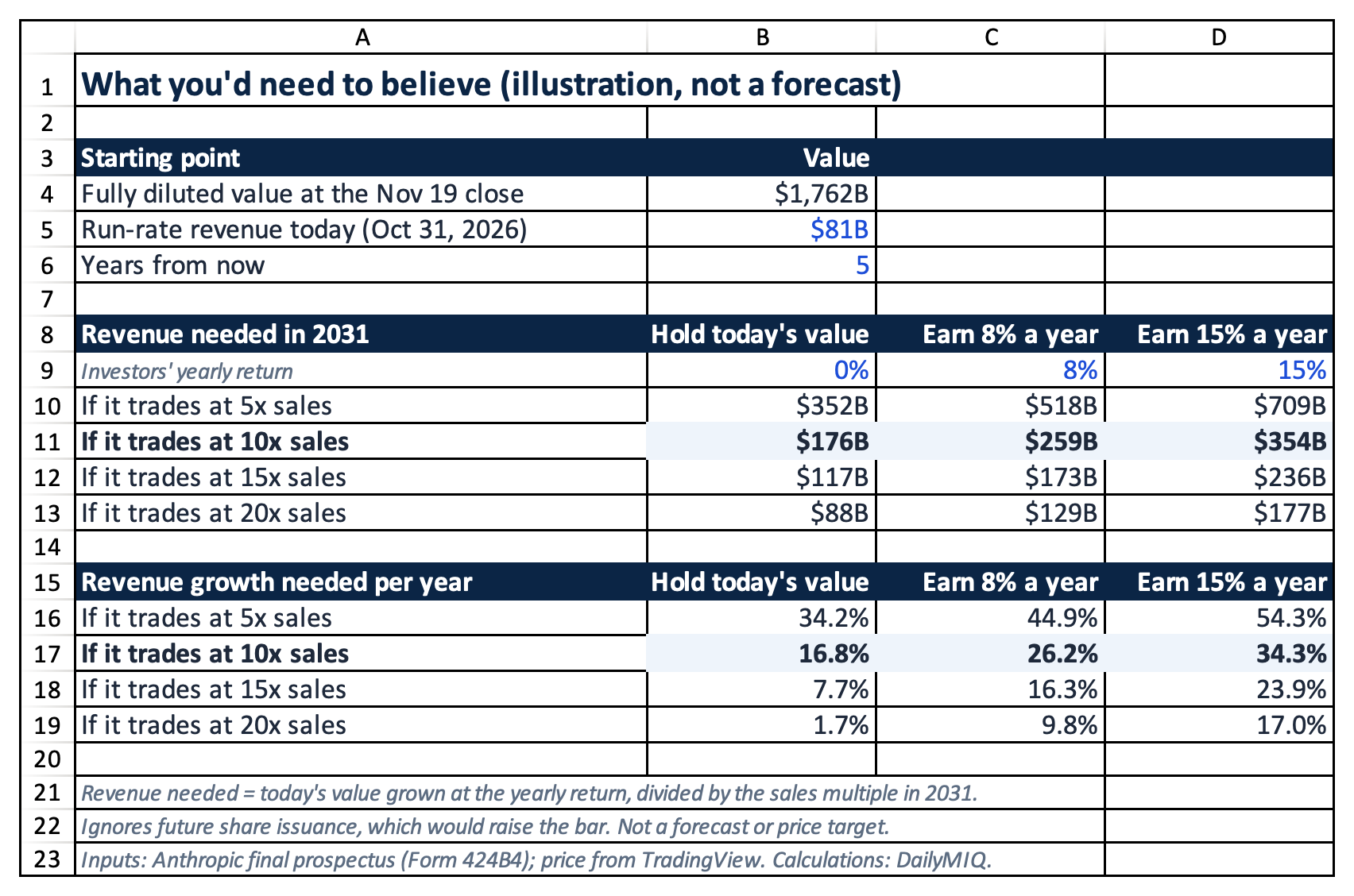
This is an illustration, not a forecast or a price target. It also ignores the new shares Anthropic will keep issuing, which would raise the bar further.
We’ve since built a five-year model that tests whether Anthropic can actually get there, and pay its computing bills along the way: Anthropic in 2031: Three Scenarios for Revenue, Profit, and Cash Flow.
What the future looks like
The bull case
- Customers paying $100,000+ a year jumped from about 950 to more than 11,900 in twelve months.
- As a group, the customers who were already paying a year earlier spent about nine times as much in the third quarter of 2026 as in the same quarter of 2025, counting those who cut back or left. This net revenue retention of about 900% leaves out Pro, Max and Ultra subscribers.
- In the third quarter, revenue grew 1,127% from a year earlier while computing costs grew 382%.
- The adjusted operating margin went from −123% to +12% in a year.
- No single customer is more than 10% of revenue.
The bear case
- About $900.9 billion of spending commitments, roughly 3.6 times its liquidity plus the IPO money combined.
- At about 22 times run-rate revenue (its price-to-sales ratio), a lot of growth is already priced in.
- Concentration risk: the top five customers bring in about 25% of revenue, and 44% flows through Amazon, Google and Microsoft’s cloud stores. Those three are also investors, suppliers and rivals.
- The Department of War labeled Anthropic a supply-chain risk. A lower court sided with Anthropic, but an appeals court upheld one designation 2–1 in September. Anthropic has asked the full court to rehear it.
- Going public triggers about $14.7 billion of stock-pay expense, with $24.1 billion more over about two years, plus dilution from options, notes and planned share gifts to its public benefit fund.
- Most insiders face a 180-day lock-up period and the co-founders up to a year, but staged early releases start sooner, so more shares can reach the market.
The bottom line
Anthropic doesn’t have a revenue problem. The question is whether a company that has committed close to a trillion dollars to computing power can grow into a $1.76 trillion price tag before the bills come due.
Sources
- Anthropic, PBC (SEC EDGAR): Final prospectus (Form 424B4) (Nov 18, 2026)
- TradingView: Anthropic, PBC (NASDAQ: ANT) stock price and chart (Nov 19, 2026 session)
Images: Claude logo by Anthropic, public domain, via Wikimedia Commons. Dario Amodei photo by TechCrunch, CC BY 2.0. Spreadsheets by DailyMIQ.
Company figures come from Anthropic’s final prospectus. Day-one trading prices come from TradingView. Fully diluted value, free cash flow, gross margin, per-employee figures, valuation multiples and the 2031 scenarios are DailyMIQ calculations from the prospectus. Market values are as of the November 19, 2026 close and change daily. This article is for education only and is not investment advice.